
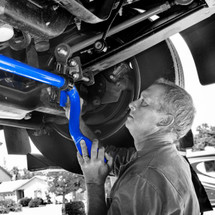
What is a Sway Bar?

What is a Sway Bar?

Why Does a Sway Bar Matter for Safer, More Stable Driving?

If you’ve ever felt your motorhome lean in a turn or get pushed around by wind or passing trucks, you’ve experienced what’s called Sway or body roll.
 
That leaning feeling is not just uncomfortable. It is a sign that your suspension is struggling to keep your vehicle stable. And that is exactly what a sway bar is designed to help control.
 
What is a Sway Bar?
 

A sway bar, also called an anti-sway bar or stabilizer bar, is a key component of your vehicle’s suspension system that helps reduce body roll during turns and side-to-side movement.


Body roll is the leaning motion you feel when your vehicle’s weight shifts during a turn or when external forces act on it.

 
A sway bar connects the left and right sides of your suspension and works like a torsion spring. When one side of the vehicle moves differently than the other, the bar resists that motion and helps keep the vehicle more level.
In simple terms, it keeps your vehicle from leaning too much and helps you stay in control.

What Does a Sway Bar Do?


When your vehicle enters a turn, weight shifts toward the outside of the curve.
Without resistance, that shift causes the body to lean.
 
A sway bar helps by:
  • Reducing body roll
  • Keeping tires planted more evenly
  • Improving stability and control
  • Reducing driver fatigue


For a motorhome, this improvement in handling can completely change the driving experience.


How Does a Sway Bar Work?


When you turn:

• The outside suspension compresses

• The inside suspension extends

• This creates uneven movement across the axle


The sway bar connects both sides and twists as this happens.That twisting action resists the difference in motion and pushes back against body roll, helping keep the vehicle more level.

Why Does Body Roll Matter More in Motorhomes?


Motorhomes are especially prone to body roll because of three main factors:
 
1. Height
A higher center of gravity creates more leverage when weight shifts.
 
2. Weight
Motorhomes carry significant weight that moves during turns and braking.
 
3. Length and Rear Overhang
This is where things get really important.
 
On gas Class A motorhomes like the Ford F53 chassis, a large portion of the coach extends behind the rear axle.
That rear overhang acts like a lever.
 
So when wind hits the side of the coach or a truck passes, it pushes the rear of the vehicle, which creates a steering effect at the front.
 
This is what many drivers describe as:
👉 “getting pushed around.”
👉 “tail wagging the dog.
 
And it is a major contributor to driver fatigue!

What Causes Body Roll in Motorhomes?


Body roll is not caused by just one thing. It is a combination of:

• High center of gravity

• Weight distribution

• Suspension flexibility

• External forces like wind and road conditions

• And most importantly, how much resistance your sway bar provides


If the system does not have enough resistance, the vehicle will lean more than it should.

Why Does Sway Bar Size Matter?


Not all sway bars perform the same. One of the biggest differences comes down to diameter. A sway bar’s resistance to body roll increases exponentially with size, not gradually.
 
As a general rule:
👉 An increase of just 1/8 inch in sway bar diameter can increase body roll resistance by up to 30 percent
That is a significant gain from a relatively small change.
 
This is why two vehicles can both have sway bars and still feel completely different on the road.

Why Do Factory Sway Bars Often Fall Short?

 
Factory sway bars are built with compromise in mind.
 
Manufacturers must balance:

• Cost

• Ride comfort

• Fuel efficiency

• Mass production


So the result is typically a sway bar that is:

• Thinner

• More flexible

• Designed to be acceptable across many conditions


But motorhomes do not operate under average conditions. The added weight, height, and rear overhang push these components to their limits.

What is The Importance of Heat Treatment?

 
Diameter is only part of the equation. Material strength matters just as much.
 
A properly heat-treated sway bar is:

• Stronger

• More resistant to fatigue

• Better at maintaining its shape under load


Without proper heat treatment, a sway bar can:

• Flex too easily

• Lose effectiveness over time

• Weaken under repeated stress


With proper heat treatment, the bar maintains consistent performance mile after mile

How Does a Rear Sway Bar affect a Ford F53 Chasiss?

 
On a gas Class A motorhome like the Ford F53, the rear sway bar plays a critical role. Because of the rear overhang, most of the unwanted movement originates from the back of the coach.
 
A properly functioning rear sway bar:

• Reduces side to side movement at the rear

• Minimizes the “push” from passing trucks

• Helps keep the vehicle tracking straight

• Improves overall driver confidence


When the rear is controlled, the entire vehicle feels more stable.

What Are Signs That My Sway Bar is NOT Doing its Job?

 
If your sway control is lacking, you may notice:

• Excessive body roll in turns

• Constant steering corrections

• Feeling pushed by wind

• Rear of the coach moving independently

• Driver fatigue after short distances


These are all signs that your suspension system is not providing enough resistance.

Why does a Sway Bar matter for Safer Driving?

 
A sway bar is not just about comfort. It is about control.
 
When your vehicle stays level:

• Your tires stay planted

• Your steering stays predictable

• Your confidence increases


And when confidence increases, fatigue decreases.
In conclusion, a sway bar is a simple component with a big responsibility. But not all sway bars are created equal. Small differences in diameter, material, and design can significantly affect how your vehicle handles. If your motorhome feels unstable, leans excessively, or leaves you worn out after a drive, it is worth taking a closer look at how well your sway control system is really performing.
 
Because the goal is not just getting there. It is getting there with control, confidence, and peace of mind. Thanks for reading this blog, and until next time, we wish you safer and happier driving.

Featured Products

Sold out
Sold out
Sold out