
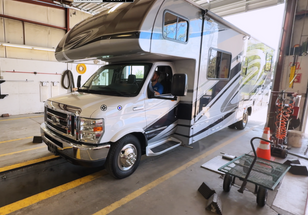
Why Your Ford E450 RV Doesn’t Drive Right (And What to Check First)
Why Your Ford E450 RV Doesn’t Drive Right (And What to Check First)
Having steering or handling issues with your Ford E450 RV? Learn the most common problems, what causes them, and what to check before upgrading your suspension.
Part 3 of Our Ford E450 R&D Series
If you’ve been following along with our Ford E450 R&D project, this is where things start to get really interesting.
In:
•Part 1, we introduced the coach
•Part 2, we took it on a real-world test drive
And now in Part 3:
-We bring the E450 into the shop for a full inspection
Because before you start upgrading anything, you need to answer one question:
-What’s actually causing the way this RV drives?
What’s the goal of this inspection?
The goal is simple:
-Identify every factor affecting how this E450 drives
That includes:
•Steering components
•Suspension design
•Tires and wheel condition
•Weight distribution
This is part of our Road Performance Assessment (RPA) process—a full front-to-back evaluation of the chassis
What are the most common E450 handling problems?
From both the test drive and inspection, we’re seeing:
•Steering play and looseness
•Pulling to one side
•Vibration from the front end
•Harsh ride quality
•General instability
And importantly—these issues are stacking together, not happening in isolation
What did we find in the steering system?
One of the first things we checked:
-The steering gearbox
We found:
•Noticeable play in the sector shaft
•Potential need for adjustment—or replacement
This could be contributing to:
•Loose steering feel
•Difficulty holding a straight line
But here’s the key:
We won’t know how much it matters until other issues (like pull) are addressed
Why does the E450 steering feel vague?
A big reason is the design:
-Twin I-beam front suspension
This system is:
•Extremely durable
•Proven over decades
But it also:
•Allows camber change through suspension travel
•Introduces more steering movement
•Feels less precise than modern designs
What is bump steer—and did we see it?
Yes—and it showed up clearly in the test drive.
Bump steer = the steering wheel moves when hitting bumps
We noticed:
•The wheel “walking” during rough road sections
•More input needed to stay straight
This is largely due to:
•Suspension geometry
•Steering linkage layout
Could the tires be part of the problem?
Absolutely—and in this case, they likely are.
We found:
•A noticeable “hop” in one front tire (runout issue)
That can cause:
•Vibration
•Steering shake
•Even pulling
Our next step: swapping tires side-to-side to test the effect
What about wheel bearings?
We also found:
-Play in the front wheel bearings
That’s important because it can lead to:
•Tire wear
•Instability
•Long-term component damage
The good news:
These are adjustable and serviceable on the E450
How are the factory shocks performing?
At ~32,000 miles and 10 years old:
-They’re worn out
Factory shocks:
•Aren’t great to begin with
•Lose effectiveness over time
This contributes to:
•Harsh ride
•Poor damping
•Increased vibration
Future step: upgrading to KONI shocks for comparison
What did we find in the rear suspension?
A few key things stood out:
Leaf springs
•Not severely sagged
•Airbags helping maintain ride height
Airbag brackets
•Early signs of cracking
•Stress points developing
This is exactly the kind of issue you only catch with a detailed inspection
Why does this RV feel unstable on the highway?
One major missing component:
-No rear track bar
That means:
•The rear axle can shift side to side
•You get “tail wag”
•Passing trucks create push-pull effects
What will fix that rear instability?
We’ll be installing:
-A rear track bar (SS450 for this setup)
This will:
•Center the axle
•Reduce sway
•Improve straight-line stability
What role do sway bars play?
The factory sway bars are:
Small—and already showing wear in the bushings
That reduces their effectiveness over time.
Future upgrade:
This will:
•Reduce body roll
•Improve handling
What’s the biggest takeaway from this inspection?
This is the most important point:
-There is no single “problem” with this RV
Instead, it’s:
•Steering play
•Tire issues
•Worn shocks
•Suspension limitations
•Missing components
All combining into one driving experience
What’s Next in the E450 Series?
Now that we’ve completed the inspection, the next step is:
-Fixing the steering pull
We’ll be:
•Swapping tires
•Performing a full alignment
•Re-evaluating the drive
From there, we’ll begin installing upgrades one step at a time so you can see exactly what each one does.
Why Does This Step Matter?
This inspection is the foundation of everything that comes next.
Because without understanding:
•What’s worn
•What’s out of spec
•What’s missing
You’re just guessing and when it comes to RV handling:
Guessing gets expensive fast
Need Help Diagnosing Your RV Handling?
If your RV doesn’t feel right, starting with a thorough inspection is always the best move. Our team at SuperSteer and Henderson's Line-Up is here to help you sort through the details—because when it comes to RV performance, small issues can add up quickly. Better diagnosis. Smarter upgrades. More confident driving. Thank you for reading this blog. Until next time we wish you safer and happier driving.