
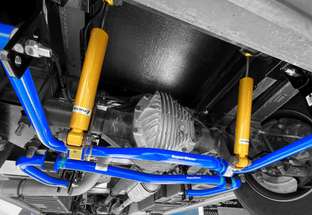
Which Way Should KONI RV Shocks Be Installed? A Simple Guide
Which Way Should KONI RV Shocks Be Installed? A Simple Guide
Installing RV shocks the right way matter. Learn correct KONI shock orientation, common mistakes, and how improper installation affects ride quality ad performance.
Does shock orientation really matter?
If youre installing or upgrading your RV shocks, you might be wondering:
Does it really matter which way the shock goes?
Short answer: Yes—it matters more than most people realize.
Installing a shock incorrectly can lead to:
•Poor ride quality
•Reduced control
•Premature performance issues
Which way should a KONI EVO shock be installed?
The easiest way to tell:
Look for the arrow labeled “TOP”
· The arrow should always point up toward the top of the shock
· The main body stays at the bottom
· The shaft (thinner rod) goes up
Even if it looks backwards—it’s not.
That arrow is there for a reason.
Why does shock orientation matter?
KONI EVO shocks are twin tube shocks, and their design depends on gravity to work properly.
Inside the shock:
•There’s an inner cylinder and an outer cylinder
•A base valve (foot valve) provides compression damping by controlling fluid movement from the inner cylinder to the outer cylinder as the shock is compressed
•Fluid must stay in contact with that valve
-When installed correctly, everything works as designed
-When installed upside down, it doesn’t
Because:
•Fluid shifts away from the valve, dramatically reducing compression damping
•Air can mix into the system
•Damping performance is reduced in both directions
How will my ride and handling be impacted if my shocks are installed upside down?
This is where problems start to show up.
When installed incorrectly, you may experience:
•Reduced damping control
•Inconsistent resistance
•A “soft” or weak feeling shock
•Increased bouncing or porpoising
•Loss of ride stability
In some cases, people assume:
“These shocks are junk”
But in reality… It’s often just an installation issue
What does a properly installed shock feel like?
When installed correctly, a KONI EVO shock should feel:
•Strong and controlled
•Smooth through its travel
•Firm in rebound (extension)
•Consistent in performance
This is what gives you:
•Better ride comfort
•Improved handling
•More stability on the road
Why do some KONI shocks look like they’re installed upside down?
Good question—and this confuses a lot of people.
Sometimes you’ll notice:
•The chrome shaft is exposed
•There’s no dust cover
This can make it look like the shock is flipped the wrong way.
But in many cases:
It’s installed correctly
Some shock designs:
•Don’t include a dust cover
•Are built for tight clearance applications
So appearance alone can be misleading.
Do you need a dust cover on RV shocks?
Not necessarily.
While many shocks include a dust cover:
•It’s not required for performance
•It does not determine durability
KONI designs their shocks with:
•Multiple seals
•Protective components
The shock is still fully protected—even without a dust cover. There are KONI applications with years of great performance, such as the 8805-1019 rear F53 FSD shock, which have never incorporated a dust cover.
Can improper installation damage the shock?
Not always—but it will affect performance.
If installed upside down:
•Air can enter the system
•Damping becomes inconsistent
The good news:
This usually doesn’t mean the shock is ruined
How do you fix a shock that was installed incorrectly?
If you discover the shock was installed wrong:
Step 1: Remove the shock
Step 2: Cycle it manually
•Compress and extend it fully
•Repeat multiple times
This helps:
•Remove trapped air
•Restore proper fluid movement
Step 3: Reinstall it correctly
•Make sure the arrow points up
Once corrected, performance should return to normal
What are signs your RV shocks might be installed wrong?
Watch for these symptoms:
•Excessive bouncing
•Poor ride control
•Inconsistent shock resistance
•Clunking or sudden movement
•Increased body motion (porpoising)
If you notice these:
It’s worth double-checking installation before jumping to replacing parts
What’s the biggest mistake people make with shocks?
The biggest mistake is simple:
-Ignoring orientation
It’s easy to assume:
•“It fits, so it must be right”
But with shocks:
•Fitment ≠ correct installation
And that small detail can make a big difference in how your RV drives.
Shock installation might seem straightforward—but orientation is one detail you don’t want to overlook.
Getting it right means:
•Better ride quality
•Improved control
•Longer-lasting performance
Getting it wrong means:
•Frustration
•Poor handling
•Unnecessary replacements
Need Help With Your RV Suspension?
If you’re unsure about:
•Shock compatibility
•Installation
•Ride quality issues
If you’re unsure about your setup, it’s always a good idea to get a second opinion. Our team at SuperSteer and Henderson's Line-Up is here to help you sort through the details—because when it comes to RV handling, the small things can make a big difference.
Better installation. Better performance. Better driving experience.
Thank you for reading this blog and we wish you safer and happier driving!