
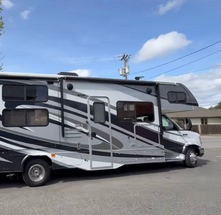
Can a Tire Really Cause Your RV to Pull? (Ford E450 Handling Q&A)
Can a Tire Really Cause Your RV to Pull? (Ford E450 Handling Q&A)
Can bad tires cause steering pull and handling issues in a Ford E450 RV? Learn how tire problems affect steering, ride quality, vibration, and overall handling.
Could Your Tires Be Causing RV Handling Problems?
If your RV:
•Pulls to one side
•Wanders
•Vibrates
•Feels unstable or difficult to control
…it’s easy to assume you need major suspension upgrades.
But sometimes:
The problem starts with something much simpler
In Part 4 of our Ford E450 suspension and handling series, we revisited our coach after making one surprisingly small change:
Swapping the front tires side to side
And the results were immediate.
What changed after swapping the tires?
The biggest improvement:
The hard pull to the left was mostly gone
Before the swap:
•The steering wheel constantly wanted to pull left
•Holding the RV straight required constant correction
After the swap:
•The RV tracked noticeably straighter
•Steering felt more neutral side-to-side
Can a bad tire really cause a steering pull?
Absolutely.
A tire with:
•Uneven wear
•Internal defects in radial belt alignment
Out-of-round conditions (“hop”)
•Can create:
•Pulling
•Vibration
•Steering instability
And in this case:
The issue followed the tire when it was moved to the opposite side
What is an “out-of-round” tire?
An out-of-round tire means:
The tire isn’t perfectly round as it rotates
This creates:
•Vertical movement (“hop”)
•Vibration through the steering wheel
•Inconsistent contact with the road
During inspection:
•A noticeable hop was seen in the front tire
Did fixing the pull solve everything?
No—and this is where things got interesting.
Once the pull was reduced:
Other issues became much more noticeable
Including:
•Steering play
•Rut tracking
•Bump steer
•General looseness on-center
Why did other problems suddenly feel worse?
Because the pull had been masking them.
Before:
•Constant pressure on the wheel hid some of the looseness
After the tire swap:
•The steering felt freer
•Existing play became much easier to notice
This is actually very common in suspension diagnostics
What steering issues still remained?
Several.
The RV still had:
•Play on-center
•Steering wheel movement over bumps (“bump steer”)
•Feedback through rough roads
Inspection pointed toward:
Wear in the steering gear sector shaft as the source of free play, while the bump steer was likely due to the inherent design limitations of the front suspension
What is bump steer?
Bump steer happens when:
The steering wheel reacts to suspension movement
You’ll notice:
•The wheel kicking during bumps
•Constant correction on uneven roads
And on the E450:
It’s especially noticeable due to the Twin I-Beam suspension design
Why does the E450 follow road ruts so much?
This is another common complaint.
The RV tended to:
•Follow grooves in the pavement
•Shift around on uneven surfaces
This is caused by a combination of:
•Steering geometry
•Tire characteristics
•Suspension movement
•Steering play
Did adding weight improve the ride?
Somewhat—but it introduced tradeoffs.
Additional ballast:
•Slightly softened harshness
•Changed how the suspension reacted
However:
•The added rear weight also increased sway during lane changes
Why does weight affect handling so much?
Because RVs are highly sensitive to load distribution.
Adding weight:
•Changes suspension behavior
•Affects ride height
•Influences stability and steering feel
In this case:
•Most added weight was placed behind the rear axle
•That increased rear movement during maneuvers
Did the RV still ride harsh after adding weight?
Yes.
Even with added ballast:
•Harshness remained noticeable
•Steering feedback stayed aggressive
•Rough roads still upset the chassis
This points toward:
Suspension limitations and shock performance
Are shocks important on the E450?
Very.
One major takeaway from this drive:
Better shocks are going to be critical
Why?
Because shocks help control:
•Bounce
•Steering movement
•Suspension oscillation
•Harshness after impacts
What upgrades were discussed next?
Several future improvements were mentioned, including:
•Alignment adjustments
•Increased caster
•Steering stabilizers
These upgrades work together to:
Improve stability and reduce driver fatigue
What does caster do for RV handling?
Caster helps:
•Improve straight-line tracking
•Increase steering return-to-center
•Reduce wandering
More positive caster generally:
Makes the RV feel more stable on the highway
Would a steering stabilizer help this RV?
Very likely.
The discussion highlighted how systems like:
Can help by:
•Damping steering movement
•Improving return-to-center
•Reducing driver fatigue
Especially on:
•Uneven roads
•Windy highways
•Heavy towing setups
What’s the biggest lesson from this test drive?
This is the key takeaway:
Small issues can create huge handling symptoms
And often:
•One problem masks another
That’s why proper diagnosis matters so much.
Because before upgrading parts:
You need to understand what’s actually causing the problem
What’s Next in the E450 Series?
Next steps include:
•Full alignment adjustments
•Further steering evaluation
•Suspension upgrades
•Shock testing
The goal:
Improve the RV one step at a time and show exactly what each change does
Final Thoughts: Don’t Overlook the Basics
When an RV drives poorly, it’s tempting to jump straight to major upgrades.
But sometimes:
A tire issue is part of the story
The reality is:
•Tires
•Steering
•Suspension
•Weight distribution
…all work together to shape how your RV drives.
Need Help Diagnosing RV Handling Problems?
If your RV:
•Pulls
•Wanders
•Vibrates
•Feels unstable
…it’s worth taking a closer look before guessing at solutions.
Because the right diagnosis leads to the right upgrades—and a much better driving experience. Give our Team at Henderson's Line-Up and SuperSteer a call to learn more. We want to help you experience more confidence behind the wheel. Thank you for reading this blog and we wish you safer and happier driving.