
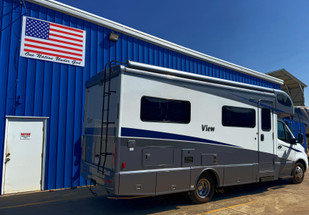
Why Your Sprinter RV Rides Harsh (And How to Fix It)
Why Your Sprinter RV Rides Harsh (And How to Fix It)
Why does your Sprinter RV feel harsh over bumps? Learn how factory leaf springs work, why they struggle in RV applications, and what upgrades improve ride quality and control.
Why Does Your Sprinter RV Ride So Harsh?
If you’ve driven a Sprinter-based RV and felt:
•A hard “slam” over bumps
•A stiff or choppy ride
•Less control than expected
You’re not alone.
This is one of the most common complaints from Sprinter 3500 RV owners—especially Class C motorhomes.
The reason comes down to something most people never think about:
How the factory rear leaf springs are designed
How is the factory Sprinter 3500 suspension designed?
From the factory, the Sprinter 3500 uses a progressive leaf spring design on the rear suspension.
That means:
•The top two leaves handle lighter loads
•A lower “overload” leaf only engages under heavier compression
So initially:
-The suspension is softer
But as it compresses:
-The spring rate increases quickly
Why is the factory setup designed this way?
Because the Sprinter chassis is used for multiple applications, like:
•Cargo vans
•Work vehicles
•Delivery vans
In those cases:
•The vehicle may run empty or lightly loaded
•A softer initial spring rate improves comfort
So the design makes sense for: Variable load vehicles
Why doesn’t that work well for RVs?
Here’s the problem:
-RVs are almost always heavy
In fact:
•Many Sprinter RVs run close to their rear axle weight rating (GAWR)
•Often within just a few hundred pounds of max capacity
So instead of using the “soft” part of the suspension:
You’re almost always riding in the stiffer overload range
What does that feel like when driving?
When the overload leaf is constantly engaged, you’ll notice:
•A harsher ride over bumps
•A “slamming” feeling on impacts
•Less smooth suspension travel
Especially when:
•Hitting speed bumps
•Driving on uneven roads
Why does the ride feel so stiff at times?
Because the spring rate ramps up quickly.
Once that lower overload leaf engages:
-The suspension becomes much stiffer in the last part of its travel
This leads to:
•Less absorption of bumps
•More force transferred into the coach
Is there a better spring setup for RV use?
Yes—and it’s simpler than you might think.
Instead of a progressive design:
-A fully engaged spring pack works better for RVs
That means:
•All leaves are working from the start
•The load is distributed more evenly
•The spring rate is more consistent
How does a different spring design improve ride quality?
A properly designed spring pack can:
•Engage earlier in the suspension travel
•Provide better support immediately
•Allow for a lower effective spring rate overall
That results in:
•Smoother ride
•Less harsh impact
•Better control
You get support without the stiffness spike
Why not just replace the entire spring pack?
That’s one option—but it’s not always practical.
On many RV builds:
•Tanks, generators, or compartments block access
•Removing the main leaf can be difficult
In some cases:
You physically can’t remove the spring eye bolts easily due to clearance issues without cutting the bolt head off, cutting holes in compartments, and/or moving a holding tank or generator out of the way.
Is there an easier alternative?
Yes—modifying part of the spring pack instead of replacing everything.
This approach:
•Keeps the main leaf in place
•Removes the second leaf
•Removes the third, lower overload leaf
Then adds:
A properly designed multi-leaf pack underneath
What does this type of upgrade improve?
By redesigning the spring pack, you can:
•Improve ride quality
•Reduce harshness
•Increase stability
•Improve control
•Restore proper suspension geometry
Can this fix “reverse arch” issues?
Yes—and that’s a big benefit.
Many Sprinter RVs develop:
-Reverse arch (springs flattening or bending the wrong way)
This happens because:
-The overload leaf isn’t engaged until the spring is already flat
A better spring setup:
•Restores proper arch
•Improves ride height
•Supports the load correctly
Will this change ride height?
It can—but it’s adjustable.
Depending on setup:
•You may gain around ~1 inch of ride height
•Height can be tuned based on:
•Number of leaves
•Spacer configuration
The goal is to match the suspension to your specific RV
Does this also help with handling?
Yes—and this is often overlooked.
A better spring pack:
•Reduces excessive movement
•Improves stability
•Helps resist sway
So you’re not just improving comfort: You’re improving control too
Why don’t bolt-on overload spring upgrades always work on Sprinter RVs?
Because of space and fitment limitations.
Many add-on solutions:
•Mount above the spring pack
•Require extra clearance
But on RVs like LTVs:
•Space is limited
•Components are tightly packed
That makes some upgrades difficult—or impossible—to install cleanly
What’s the biggest takeaway for Sprinter RV owners?
This is the key point:
-The factory suspension wasn’t designed specifically for RV use
It’s a compromise design for multiple applications.
So when you load it like an RV:
-The limitations start to show
A Better Ride Starts with Better Support
If your Sprinter RV feels harsh, stiff, or uncontrolled:
-It’s not just “how they are”
It’s a result of:
•Spring design
•Weight distribution
•Suspension limitations
The good news?
-With the right setup, you can dramatically improve both ride quality and handling
Need Help Improving Your Sprinter Ride?
If you’re dealing with harsh ride quality or poor suspension performance, it’s worth taking a closer look at how your setup is working. Our team of experts at Henderson's Line-Up are here to help you because when your suspension is properly matched to your RV: every drive becomes smoother, more controlled, and more enjoyable.
Less harshness. Better control. A smoother ride every mile. Thank you for reading this blog. Until next time we wish you safer and happier driving.
Published: May 2026
About the Author:
Tommy Henderson is the third-generation CEO of Henderson’s Line-Up and holds a bachelor’s degree in mechanical engineering. Growing up in the family business, Tommy has spent his career around RV steering, suspension, alignment, and handling. Today, he continues Henderson’s Line-Up’s hands-on approach to solving RV handling problems while helping develop solutions through SuperSteer, the parts and product division of Henderson’s Line-Up.