
Heat-Treated vs. Standard Anti-Sway Bars: What Is the Difference?
Heat-Treated vs. Standard Anti-Sway Bars: What Is the Difference?
What makes a heat-treated anti-sway bar different? Learn how annealed and tempered sway bars differ and why tempering can improve sway control and performance.
When shopping for an anti-sway bar, you may notice that some SuperSteer products are specifically described as heat treated, while others are not.
What does that actually mean?
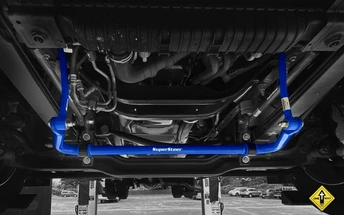
At first glance, two anti-sway bars may look very similar. They may even be the same diameter. However, the way the steel is processed can affect how the bar performs when it is repeatedly twisted as your motorhome, truck, or other vehicle leans from side to side.
To understand the difference, we need to look at two different processes: annealing and tempering.
Are All Anti-Sway Bars Heat Treated?
Technically, yes.
The anti-sway bars we sell undergo a heat-treatment process known as annealing. However, when SuperSteer specifically identifies one of our anti-sway bars as heat treated, we are generally referring to an additional tempering process used on many of our SS-series anti-sway bars. That means the more technically accurate comparison is not necessarily a "heat-treated" bar versus a bar that has received no heat treatment at all. It is an annealed anti-sway bar versus a tempered anti-sway bar. That additional tempering process is where we have seen a noticeable difference in sway bar performance.
Does a Heat-Treated Anti-Sway Bar Provide More Sway Control?
In our experience, yes.
When comparing a non-tempered anti-sway bar with a tempered version of the same bar, we have found that the tempered bar can provide noticeably more sway control. From our real-world experience, the performance difference can feel similar to adding approximately another 1/8 inch of sway bar diameter. This became particularly noticeable during the development of the SuperSteer SS101. We already had experience with the Roadmaster 1139-148 and wanted to determine what would happen if we added the tempering process. The result was a bar that performed noticeably better. Since then, we have seen similar results across multiple anti-sway bar applications.
Should You Choose a Tempered Anti-Sway Bar?
If you are deciding between a non-tempered and tempered version of the same anti-sway bar, budget will naturally be part of the decision. When your budget allows, however, we generally recommend choosing the tempered anti-sway bar because of the higher level of performance we have experienced from the additional heat-treatment process. Understanding why requires getting a little deeper into how steel behaves under stress.
What Is Yield Stress?
One way to understand the difference between annealed and tempered steel is through a stress-strain curve.
Tempered steel has a higher yield stress than annealed steel. An easy way to visualize yield stress is to think about bending a paperclip. If you bend a paperclip slightly and let go, it springs back to its original position. Continue bending it farther, however, and eventually it reaches a point where it no longer returns completely to its original shape. That point is related to the material's yield stress. Before reaching its yield point, the material is operating within its elastic range. Once it goes beyond that point, permanent deformation begins.
What Is the Difference Between Elastic and Plastic Deformation?
Before steel reaches its yield point, it operates within what is known as the elastic region. In this region, the material can be twisted, bent, or stretched and still return toward its original shape when the force is removed. Once the material begins to exceed its yield stress, it enters plastic deformation. At that point, additional strain, such as elongation, twisting, or stretching, can occur without requiring the same proportional increase in force. Returning to the paperclip example, you can feel this happen once the paperclip has been bent far enough. It becomes easier to continue bending because the material has moved beyond its original elastic behavior. Tempering steel raises its yield stress, allowing it to maintain consistent elastic behavior through a wider range of stress. That characteristic is particularly useful when the component we are discussing is a spring.
An Anti-Sway Bar Is a Spring
At its most basic level, an anti-sway bar is essentially a U-shaped spring. As the vehicle leans from one side to the other, the anti-sway bar twists. The more force required to twist that spring a given amount, the greater the resistance it can provide against body roll. This is one reason the properties of the steel itself matter. If the material can maintain consistent resistance through a greater range of twisting, the anti-sway bar can provide more consistent resistance to vehicle lean. This helps explain why we have experienced improved sway control from tempered anti-sway bars.
Why Does Anti-Sway Bar Diameter Matter?
Heat treatment is not the only factor affecting sway bar performance.
Diameter also matters.
A larger-diameter anti-sway bar can provide greater resistance to sway because it requires more force to twist the bar a given amount. This is why increasing sway bar diameter is one way to increase roll resistance. Tempering provides another way to improve the performance characteristics of the bar. In our experience, the added tempering process can create a noticeable performance improvement even when comparing bars of the same diameter.
Where Is the Most Stress in an Anti-Sway Bar?
When an anti-sway bar twists, the stress is not distributed evenly throughout the entire cross-section of the bar. With a circular bar under torsion, the stress is highest toward the outside of the bar and approaches zero toward the center. This also helps explain why tubular anti-sway bars can be effective. The material toward the outer portion of the bar contributes much more to resisting twisting than the material near the center. Understanding how stress is distributed through the bar also helps explain why an anti-sway bar does not necessarily need to become visibly bent or broken before differences in material properties can affect its performance.
Can an Anti-Sway Bar Permanently Bend?
It is possible for areas of a sway bar to begin approaching yield stress without the entire bar developing an obvious permanent bend. The stress varies throughout the cross-section, so localized areas can experience greater stress than others. As the vehicle returns from a lean, the bar may also recover rather than remaining visibly deformed. In practice, we rarely see anti-sway bars actually break because they have exceeded yield or ultimate stress across enough of the bar's cross-section to create a fatigue failure. The more noticeable difference we see from tempering is performance. A tempered anti-sway bar provides more consistent resistance to lean through a wider range of twisting.
Why Are Tempered Anti-Sway Bars Used in Heavy-Duty Applications?
SuperSteer's primary anti-sway bar supplier, Roadmaster, also supplies bars for other heavy-duty applications, including defense, truck, and bus applications. Many of those customers also specify tempered anti-sway bars. That reinforces the value of tempering in applications where durability and performance are important. From the SuperSteer perspective, one of the biggest benefits we have experienced is improved anti-sway bar performance and more consistent resistance to vehicle lean.
Which SuperSteer Anti-Sway Bars Are Tempered?
Several SuperSteer SS-series anti-sway bars specifically use the tempering process discussed in this article.
These include:
- SuperSteer SS101
- SuperSteer SS110
- SuperSteer SS218
- SuperSteer SS219
- SuperSteer SS203
- SuperSteer SS107
- SuperSteer SS102
- SuperSteer SS111
These are what we mean when we describe an anti-sway bar as heat treated in this context. They have undergone the additional tempering process that differentiates them from an anti-sway bar that has only been annealed.
Is a Heat-Treated Anti-Sway Bar Worth It?
If you are comparing a tempered anti-sway bar with a non-tempered version of the same bar, the biggest consideration will likely be performance versus budget. Our experience has shown that tempering can noticeably improve how effectively an anti-sway bar controls vehicle lean. The difference has been significant enough that we have compared the performance improvement to what you might experience from adding approximately another 1/8 inch of sway bar diameter. That does not mean diameter is no longer important. Diameter, bar design, material properties, and heat treatment all contribute to how an anti-sway bar performs. Tempering gives us another way to improve the performance of the spring without looking only at bar diameter.
What Does This Mean When Choosing an Anti-Sway Bar?
Seeing the words "heat treated" in an anti-sway bar description is more than just marketing terminology. Technically, the anti-sway bars discussed here have undergone annealing. When SuperSteer specifically calls one of our SS-series bars heat treated, we are referring to the additional tempering process. That process increases the steel's yield stress and allows the material to maintain consistent elastic behavior through a wider range of twisting. For an anti-sway bar, that matters because the bar itself is a spring. The more consistently that spring can resist twisting as the vehicle leans, the more effectively it can help control sway.
If you are comparing anti-sway bars and have questions about heat treatment, sway control, product selection, or which SuperSteer anti-sway bar fits your application, contact SuperSteer at 888-898-3281, email sales@supersteerparts.com, or visit supersteerparts.com. If you are interested in having an anti-sway bar or other suspension and steering upgrades professionally installed on your coach, contact Henderson's Line-Up in Grants Pass, Oregon at 541-479-2882 or visit hendersonslineup.com.
Thank you for reading this blog and until next time we wish you safer and happier driving.
Published: October 2026
About the Author:
Tommy Henderson is the third-generation CEO of Henderson’s Line-Up and holds a bachelor’s degree in mechanical engineering. Growing up in the family business, Tommy has spent his career around RV steering, suspension, alignment, and handling. Today, he continues Henderson’s Line-Up’s hands-on approach to solving RV handling problems while helping develop solutions through SuperSteer, the parts and product division of Henderson’s Line-Up.