
What Does a Sway Bar Do for an RV?
What Does a Sway Bar Do for an RV?
If your RV feels like it leans or rocks from side to side while you’re driving, you may have heard that a sway bar can help. But what does a sway bar actually do, and when should you consider upgrading one?
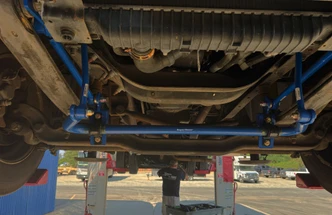
A sway bar plays an important role in controlling the side-to-side movement of a motorhome. Depending on the coach, there may also be opportunities to upgrade a factory sway bar or add one where a sway bar wasn't originally installed. So, let’s break down how an RV sway bar works, what it controls, and when an upgraded anti-sway bar might make sense.
What does a sway bar do for an RV?
Simply put, a sway bar helps control sway or body roll. As an RV leans to one side, the sway bar is twisted through the movement of the suspension. The sway bar then provides resistance to that movement. For example, if the coach leans to the left, the frame moves down relative to the suspension on one side and up on the other. One end of the sway bar is pushed while the other is pulled, twisting the U-shaped bar. That resistance helps control how much the motorhome leans from side to side.
Does a bigger sway bar provide more sway control?
The diameter of the sway bar plays a role in how much resistance it provides. The sway bar general rule is that every additional 1/8 in helps reduce body roll resistance by 30% The larger the diameter of the sway bar, the more resistance it provides against sway or lean. Essentially, it’s stiffening the suspension in that direction to provide more sway control.
Will an upgraded RV sway bar make the ride stiffer?
This is an important distinction. An upgraded sway bar stiffens the suspension against side-to-side sway, but that doesn't mean it necessarily stiffens the ride when both sides of the suspension travel over something evenly, like a speed bump. In that situation, the sway bar is free to pivot. If you go extremely stiff with a sway bar and hit a bump on only one side, it can theoretically increase the spring rate and stiffen the ride. However, in our experience with motorhome applications, we haven't felt a situation where the stiffness of the sway bar was enough compared with the stiffness of the springs themselves to actually notice it. Motorhomes also tend to have more weight up high and are built heavier, which is where an upgraded anti-sway bar can really help.
How can a front sway bar be upgraded on a Ford E350 or E450?
On older Ford E350 and E450 chassis, the factory sway bar used a rubber bushing that fit into a hole in the I-beam. Those bushings can wear out over time. An upgraded setup can use additional bracketry to create a stronger connection along with polyurethane bushings. Newer Ford E350 and E450 chassis moved away from this style of connection and use a more traditional end link. Interestingly, you can still see the hole in the I-beam where the sway bar connected with the older design.
Do all RVs come with a rear sway bar from the factory?
Not necessarily.
For example, an E350 Class B motorhome may not have a rear sway bar from the factory or even have a factory provision for a sway bar to mount to the rear axle. In this situation, Ford relies on the stiffness of the leaf springs and the shock absorbers to control sway in the rear suspension. There are times when that may not be enough, particularly on a heavier motorhome.
Why add a rear sway bar to an RV?
On a heavier motorhome, there can be a lot of weight from the house structure and components such as the water tank. In a situation like this, adding a larger rear anti-sway bar can stiffen the rear suspension to provide additional sway control. It can also help with that feeling that the back of the motorhome wants to “wash out,” while making the coach more responsive and safer to control.
What does an RV sway bar control?
An anti-sway bar specifically helps control sway and body roll by resisting the side-to-side leaning of the coach. That's an important distinction when you're trying to figure out what your motorhome is doing and what part of the suspension may need attention. On a motorhome without a rear sway bar, the manufacturer may rely on components such as the leaf springs and shock absorbers to help control the rear suspension. Adding an anti-sway bar provides another way to control sway when the existing setup isn't providing enough sway control.
When should you consider upgrading your RV sway bar?
There are a couple of situations where an RV owner may want to look at an anti-sway bar. If your motorhome didn't come with a sway bar from the factory, adding one may be an option. You might also already have factory anti-sway bars but still be looking for more stability and more sway control. In that case, upgrading to a larger anti-sway bar may be worth considering. The important thing is looking at the individual coach and what it's doing before deciding which upgrade makes sense.
Have Questions About RV Sway Bars?
If you have questions about RV sway bars, anti-sway bars, or motorhome sway control, visit SuperSteerParts.com or give us a call at (888)898-3281. If you'd like to learn more about having an upgraded sway bar installed, our team at Henderson’s Line-Up in Grants Pass, Oregon, can take a look at your coach and give you specific recommendations based on what you're experiencing. Call our shop at (541)479-2882 or visit hendersonslineup.com.
Whether your RV didn't come with a sway bar or you're looking for more stability from the anti-sway bars you already have, understanding what the sway bar actually controls is a good place to start. Thank you for reading this blog and until next time we wish you safer and happier driving.
Published: October 2026
About the Author:
Tommy Henderson is the third-generation CEO of Henderson’s Line-Up and holds a bachelor’s degree in mechanical engineering. Growing up in the family business, Tommy has spent his career around RV steering, suspension, alignment, and handling. Today, he continues Henderson’s Line-Up’s hands-on approach to solving RV handling problems while helping develop solutions through SuperSteer, the parts and product division of Henderson’s Line-Up.