
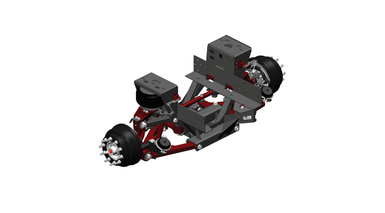
Reyco IFS 1460 Front Suspension: Common Problems, Maintenance, and Upgrades
Reyco IFS 1460 Front Suspension: Common Problems, Maintenance, and Upgrades
Learn how the Reyco IFS 1460 independent front suspension works, common steering and handling issues to watch for, maintenance tips, and the best upgrades to improve ride quality and stability.
What Is the Reyco IFS 1460 Front Suspension?
If you own a diesel pusher built on a Spartan chassis, there's a good chance it uses a Reyco independent front suspension (IFS). One of the most common versions is the Reyco IFS 1460, which is found on many high-quality motorhomes from manufacturers such as Travel Supreme and other premium coaches built during the early to mid-2000s.
Unlike a solid beam axle, an independent front suspension allows each front wheel to move independently. This generally improves ride quality, steering response, and road handling.
The model number also tells you the axle's weight rating. For example, the IFS 1460 is rated for a 14,600-pound front axle.
What Other Reyco IFS Models Are There?
Reyco produced several independent front suspension models over the years.
Common models include:
- IFS 1200
- IFS 1300
- IFS 1460
- IFS 1660
- IFS 1700
- IFS 1800
- IFS 2000
While the 1460, 1660, and 1700 share many design similarities, the larger 1800 and 2000 suspensions use a different steering arrangement with a second steering gear. This reduces steering linkage, creating a stronger design with fewer moving components that can develop play over time.
What Handling Problems Are Common on the Reyco IFS 1460?
The customer's Travel Supreme came into the shop with several common complaints:
- Excessive wandering
- Steering wheel play
- A hard pull to the right
These symptoms can have several causes, including:
- Alignment issues
- Tire pull
- Worn steering components
- Ride height problems
- Worn suspension parts
Because several components can create similar symptoms, diagnosing the entire front suspension is important before replacing parts.
Where Should You Check for Steering Play?
One of the first steps when diagnosing a Reyco suspension is checking every steering component while the coach is sitting on the ground with its full weight on the suspension.
A technician slowly moves the steering wheel back and forth while another technician watches each steering component for movement.
Important inspection points include:
- Steering gearbox
- Forward drag link ends
- Crank arm bearing
- Crank rod ends
- Bell crank bearing
- Idler bearing
- Center link ball joints (connections to bell crank and idler)
- Inner tie rods
- Outer tie rods
Even a small amount of movement in several components can combine to create noticeable steering play at the wheel.
What Parts Commonly Wear Out?
Like many independent front suspensions, the Reyco IFS contains several moving joints that naturally wear over time.
Some of the most common wear points include:
Split Dust Boots
Many steering joints use rubber boots to keep grease in and dirt out.
If a boot cracks or tears, water and debris can enter the joint. Some components do not include grease fittings, meaning contamination cannot be flushed out once the seal has failed. In these cases, replacement is usually the best option.
Bell Crank Bearings
Both front and rear bell crank assemblies should be checked for side-to-side and vertical movement.
Any looseness indicates worn bearings that can contribute to steering play and wandering.
Crank Rod End Wear
The crank rod is another common wear item.
Because it is located within the steering linkage between the pitman arm and steering arm, wear here will not change toe settings but can still create excessive steering wheel play and delayed steering response.
Tie Rod Ends
Both inner and outer tie rod ends should be inspected for looseness, damaged boots, and excessive wear.
Why Does Worn Steering Linkage Cause Wandering?
When steering components develop play, the steering wheel begins moving before the tires respond.
Instead of the coach immediately changing direction, the driver experiences a delay followed by an overcorrection.
The result is constant steering corrections that many RV owners describe as "chasing the coach" down the highway.
Should You Adjust Ride Height Without Checking the Alignment?
No.
One of the most important points with an independent front suspension is that ride height directly affects alignment.
Changing ride height changes suspension geometry, which can alter:
- Camber
- Toe
- Caster
For that reason, any ride height adjustment should be performed while the coach is on an alignment rack so the alignment can be verified afterward.
On this coach, technicians discovered:
- A low right rear corner
- A leaking ride height valve
- Air springs showing signs of dry rot
These issues all needed to be addressed as part of the overall diagnosis.
When Should Air Springs Be Replaced?
Air springs should be inspected regularly, especially on older coaches.
As rubber ages, dry rot can develop, eventually leading to air leaks or failure.
While there is no fixed replacement interval, coaches with air bags over 10 years old should be inspected carefully during routine service.
Can You Install a Safe-T-Plus on a Reyco IFS 1460?
Yes, many Reyco IFS 1460 suspensions are good candidates for a Safe-T-Plus steering control.
Because the 1460 uses a round center link and earlier models typically have sufficient clearance around the steering linkage, installation is often straightforward.
However, later model and/or larger Reyco suspensions that use square center links or have ABS valves and air system components mounted above the steering linkage may not have enough room for installation.
Fitment depends on the exact suspension model and chassis configuration.
Are All Shocks Created Equal?
No.
Many RV owners replace worn shocks only to discover the ride quality changes very little.
That's because not every shock is designed to control the weight and suspension movement of a large diesel motorhome.
Quality matters.
Even brand-new shocks may not provide the level of damping needed for optimal ride quality and vehicle control.
Which Shocks Work Well on the Reyco IFS?
This coach was equipped with Red Diamond shocks, which are equivalent to the KONI 99B-3234.
These shocks provide a noticeable improvement over smaller factory Bilstein shocks and offer a comfortable ride with good control.
However, Henderson's Line-Up has found that many Reyco-equipped coaches benefit even more from the KONI 99B-3234SP1.
Originally tested on a Power Glide chassis using the same Reyco front suspension, these heavier-duty shocks provide additional damping that helps reduce:
- Porpoising
- Front-end bounce
- Suspension oscillation
- Driver fatigue
Even lighter coaches equipped with the Reyco IFS 1460 can benefit from the additional control, particularly shorter wheelbase motorhomes that are naturally more prone to porpoising.
What Shock Mount Should You Check Before Ordering?
Reyco front suspensions use two different upper shock mounting styles.
Depending on the chassis, your coach may use either:
- Eyelet mounts
- Bar pin mounts
Knowing which mounting style your coach has is important before ordering replacement shocks.
Another important inspection point is the shock mounting hardware.
The lower bolts thread directly into the control arm and should always be installed carefully by hand before tightening.
Using an impact gun can easily damage the threads or break the mounting bolts.
In fact, this coach arrived with several broken shock mounting bolts from a previous installation, creating the risk of the shock loosening while driving.
How Does the Reyco IFS Compare to ZF and Neway Suspensions?
The Reyco IFS was an excellent suspension for its time and remains a capable design today.
However, the Neway independent front suspensions as well as the currently popular ZF independent front suspension simplify the steering system by mounting the steering gear directly to the center link. This reduces the number of steering components and wear points while providing excellent steering precision.
One advantage the Reyco design still offers is alignment flexibility, especially when compared with the older Neway IFS.
Its eccentric cam adjustment allows technicians to make significant caster and camber corrections, making it easier to compensate for ride height variations than some newer suspension designs that rely on shims with more limited adjustment.
What Does This Mean for Diesel Pusher Owners?
The Reyco IFS 1460 is a durable and capable independent front suspension, but like any steering system, it benefits from regular inspection and maintenance.
Checking steering linkage, replacing worn components, maintaining proper ride height, and selecting quality shocks can dramatically improve steering feel, ride quality, and overall driver confidence.
If your diesel pusher wanders, pulls, or has excessive steering play, diagnosing the entire front suspension is far more effective than replacing individual parts one at a time.
If you have questions about your Reyco suspension, steering components, shocks, or handling upgrades, the team at SuperSteer is here to help. Give us a call at 888-898-3281 to speak with one of our suspension specialists.
If your motorhome is due for an alignment, suspension inspection, or steering repair, schedule an appointment with Henderson's Line-Up in Grants Pass, Oregon. Our experienced technicians specialize in diagnosing and improving RV handling so you can travel with greater confidence. Call 541-479-2882 or visit hendersonslineup.com to schedule your next appointment.
Thank you for reading this blog and until next time we wish you safer and happier driving.
Published: September 2026
About the Author:
Tommy Henderson is the third-generation CEO of Henderson’s Line-Up and holds a bachelor’s degree in mechanical engineering. Growing up in the family business, Tommy has spent his career around RV steering, suspension, alignment, and handling. Today, he continues Henderson’s Line-Up’s hands-on approach to solving RV handling problems while helping develop solutions through SuperSteer, the parts and product division of Henderson’s Line-Up.