
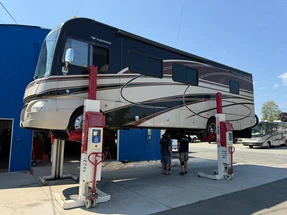
Ford F53 Suspension Upgrades: How One Couple Transformed Their Motorhome's Handling
Ford F53 Suspension Upgrades: How One Couple Transformed Their Motorhome's Handling
Frustrated with Ford F53 handling? See how sway bars, KONI EVO Shocks, a Rear Trac Bar, Radius Rods, and a Safe-T-Plus transformed one couple's motorhome.
If you own a motorhome on the Ford F53 chassis and constantly fight the steering wheel, struggle with body sway, or get pushed around by passing trucks and crosswinds, you may have wondered whether it would be easier to replace the coach entirely.
That is exactly where John and Shannon found themselves.
After owning their F53 motorhome for almost two years, they had reached the point where they were seriously considering selling it and returning to a diesel pusher. Their first long trip took them to the East Coast and back, and John described the driving experience as a "nightmare." Crosswinds and passing semi-trucks made the coach difficult to control, sometimes forcing them to travel around 35 mph on the freeway. For Shannon, the problems were just as noticeable from the passenger seat. Body sway made ordinary maneuvers, such as making a U-turn, feel much more dramatic than they actually were. Passing diesel trucks and wind added to the uncomfortable feeling.
They eventually asked themselves a difficult question: "Did we buy the wrong motorhome?"
Instead of spending hundreds of thousands of dollars to move back into a larger, heavier coach, they decided to see what could be done with the F53 they already owned. The result was a combination of suspension and steering upgrades designed to address different parts of the handling problem.
Why Can Ford F53 Handling Be Frustrating?
Poor motorhome handling is rarely as simple as one component needing to be replaced.
John and Shannon were experiencing several different symptoms:
- Excessive body sway
- Movement from crosswinds
- Push from passing trucks
- Rear-end movement
- Constant steering corrections
- An uncomfortable feeling around corners
- Movement over uneven railroad tracks
- Driver fatigue
These symptoms do not all come from the same source. That is why improving F53 handling can involve several components working together rather than expecting one upgrade to solve every problem. John and Shannon's coach ultimately received upgrades at both the front and rear to address sway, steering control, suspension movement, and tracking.
Ford F53 Rear Sway Bar Upgrades
One of the most extensive areas of their suspension upgrade was sway control.
- A rear auxiliary sway bar
- A forward-facing auxiliary sway bar
- A larger, heat-treated OEM replacement sway bar
A sway bar helps resist body roll. Increasing roll resistance helps keep the coach more controlled when cornering, entering and exiting parking lots, traveling over uneven surfaces, or being affected by outside forces. John and Shannon noticed a major improvement around corners after the upgrades. They also specifically mentioned uneven railroad tracks. Before the upgrades, crossing tracks at an angle could create considerable side-to-side movement. Afterward, they described the coach as much smoother and more controlled.
Why Do Sway Bars and Shocks Work Together?
It is tempting to look at an F53 handling problem and decide that you only need better shocks or only need a larger sway bar.
The two components perform different jobs.
A sway bar is a spring. As the coach leans, the bar twists and provides resistance. Once that force is removed, the spring naturally wants to return. The shock helps control that movement. This creates an important relationship between the sway bars and shocks. The sway bar provides roll resistance while the shock provides damping to help control suspension movement. Rather than thinking of shocks and sway bars as interchangeable solutions, it is more useful to think about how they complement one another.
KONI EVO Shocks for the Ford F53
John and Shannon's F53 also received KONI EVO Shocks at the front and rear. The front KONI shocks use FSD, or Frequency Selective Damping, which helps address the choppy feeling that can occur over surfaces such as bridge abutments. The shocks also work with the sway bars to control suspension movement rather than allowing the coach to continue oscillating after the initial movement occurs. For John and Shannon, the combination contributed to a major improvement in the way the coach felt on the road.
What Does a Rear Trac Bar Do on an F53?
Another important upgrade on their coach was a rear trac bar. The rear of a motorhome can shift laterally, or side to side, relative to the chassis. This movement is commonly associated with a handling problem often called "tail wagging the dog." When the rear of the coach moves from side to side, the driver feels that movement at the front and makes steering corrections to compensate. John described the coach before the upgrade as being "all over the place" and at times almost undrivable. The rear trac bar is designed to control that lateral movement at the rear axle. Reducing that unwanted movement can reduce the amount of correction the driver has to make at the steering wheel. For someone constantly fighting an F53 down the highway, controlling what is happening at the rear of the coach can be an important part of improving the overall driving experience.
What Does a Safe-T-Plus Do on a Ford F53?
At the front of the coach, John and Shannon also had a Safe-T-Plus Steering Control installed. The Safe-T-Plus provides centering force in either direction. When the steering is pushed away from center, the unit helps provide force back toward its centered position. That can be useful when outside forces, such as wind, affect the coach because the steering control assists with returning toward center. The Safe-T-Plus is also designed to provide additional steering control in a front tire failure. Its centering force helps the driver maintain directional control when the coach suddenly wants to pull to one side. This makes the Safe-T-Plus both a steering control upgrade and an additional safety component.
Why Upgrade the Front Sway Bar?
The front of John and Shannon's coach also received a larger heat-treated OEM replacement sway bar. Sway bar diameter makes a significant difference in roll resistance. As discussed during the inspection of their coach, every additional 1/8 inch in sway bar diameter can provide approximately 30 to 40 percent more roll resistance. Diameter is not the only factor involved. The replacement bar on this F53 is also heat treated. Increasing roll resistance at the front helps reduce unwanted body movement and works together with the other suspension components to create a more controlled driving experience.
What Do Radius Rods Do on a Ford F53?
The front suspension was also equipped with radius rods. Radius rods help control front axle movement, including movement that can occur during acceleration and braking. On this coach, they were installed to help with tracking and provide more precise steering at the front. This is another example of why an F53 handling package can involve multiple components. The rear trac bar controls unwanted movement at the rear axle. The sway bars control body roll. The shocks damp suspension movement. The Safe-T-Plus provides steering centering force. The radius rods help control movement at the front. Each component addresses a different part of the overall handling equation.
How Did the F53 Drive After the Suspension Upgrades?
The difference was significant enough that John compared the finished F53 to the diesel pusher they had previously owned. Before the upgrades, he said he could never relax at the steering wheel because he was constantly making corrections. Afterward, the coach tracked much more predictably and gave both John and Shannon considerably more confidence. Shannon described the difference as "night and day."
Their experience also gave them an unusual opportunity to evaluate the improvements. One component had been backordered, so they drove the coach for approximately a week after most of the work had been completed and then returned for the remaining upgrade. That gave them additional time on the road to experience how the coach behaved as the work was completed. They also drove the same highway, giving them a familiar point of comparison. One of the most interesting results was the difference in perceived driver fatigue. John and Shannon said a drive of approximately four to four and a half hours after the upgrades felt more like a two-hour drive had felt previously. That does not mean suspension upgrades literally shorten a trip. It demonstrates how exhausting constant steering corrections and poor handling can become during several hours behind the wheel.
Can Ford F53 Suspension Upgrades Reduce Driver Fatigue?
Driver fatigue is easy to overlook when discussing suspension. If a motorhome wanders, gets pushed around, or requires constant steering corrections, the driver has to remain physically and mentally engaged with those movements for the entire trip. Reducing unnecessary movement can make the coach easier to manage. For John and Shannon, that difference translated directly into greater driving confidence and a trip that felt considerably less exhausting.
Should You Upgrade Your F53 or Buy a Different Motorhome?
There is no single answer that applies to every owner.
For John and Shannon, however, this became one of the biggest questions they had to answer. They had previously owned a diesel pusher and were considering going back to one because they were so unhappy with the F53's handling. They wanted a shorter motorhome and had originally chosen the F53 because it fit what they were looking for. Once they began experiencing the handling problems, they questioned whether they had made a mistake. Moving back into another coach could have meant spending hundreds of thousands of dollars. Instead, they chose to improve the coach they already owned. After the upgrades, John said the F53 drove almost like a diesel pusher, despite the major differences between the two chassis designs. For them, improving the F53 allowed them to keep the motorhome they wanted while addressing the handling problems that had made them consider getting rid of it.
Are Ford F53 Suspension Upgrades Worth It?
For John and Shannon, the answer was clear.
John's recommendation to other F53 owners was not to overlook suspension upgrades if they are unhappy with how their coach drives. After experiencing the difference himself, he described the finished motorhome as feeling like a new coach, or even better. That does not mean every F53 needs the exact combination of components installed on their coach. Different handling complaints can have different causes, and the best solution depends on what the motorhome is actually doing. A coach struggling primarily with rear lateral movement may need a different solution than one suffering from excessive body roll or harsh suspension movement. The goal should be to identify the handling problems first and choose upgrades that address those specific problems.
What Does This Mean for Ford F53 Motorhome Owners?
If you are frustrated enough with your Ford F53 that you are considering replacing the entire motorhome, it may be worth finding out what is actually causing the poor handling first.
John and Shannon experienced sway, wind push, tail wag, constant steering corrections, and significant driver fatigue. Instead of relying on one component to solve everything, their F53 received a combination of upgrades designed to address different aspects of the chassis:
- Rear Auxiliary Sway Bars
- A larger heat-treated Rear Sway Bar
- KONI EVO Shocks
- A Rear Trac Bar
- Safe-T-Plus Steering Control
- A larger heat-treated Front Sway Bar
- Radius Rods
The result, according to the people actually driving and riding in the coach, was a night-and-day difference.
If you have questions about Ford F53 suspension and steering products, sway bars, shocks, trac bars, radius rods, or handling upgrades, contact SuperSteer at 888-898-3281 or visit supersteerparts.com. If your Ford F53 is difficult to control, gets pushed around by passing trucks or wind, has excessive sway, or needs a professional suspension and steering evaluation, contact Henderson's Line-Up in Grants Pass, Oregon at 541-479-2882 or visit hendersonslineup.com. Thank you for reading this blog and until next time we wish you safer and happier driving.
Published: October 2026
About the Author:
Tommy Henderson is the third-generation CEO of Henderson’s Line-Up and holds a bachelor’s degree in mechanical engineering. Growing up in the family business, Tommy has spent his career around RV steering, suspension, alignment, and handling. Today, he continues Henderson’s Line-Up’s hands-on approach to solving RV handling problems while helping develop solutions through SuperSteer, the parts and product division of Henderson’s Line-Up.